

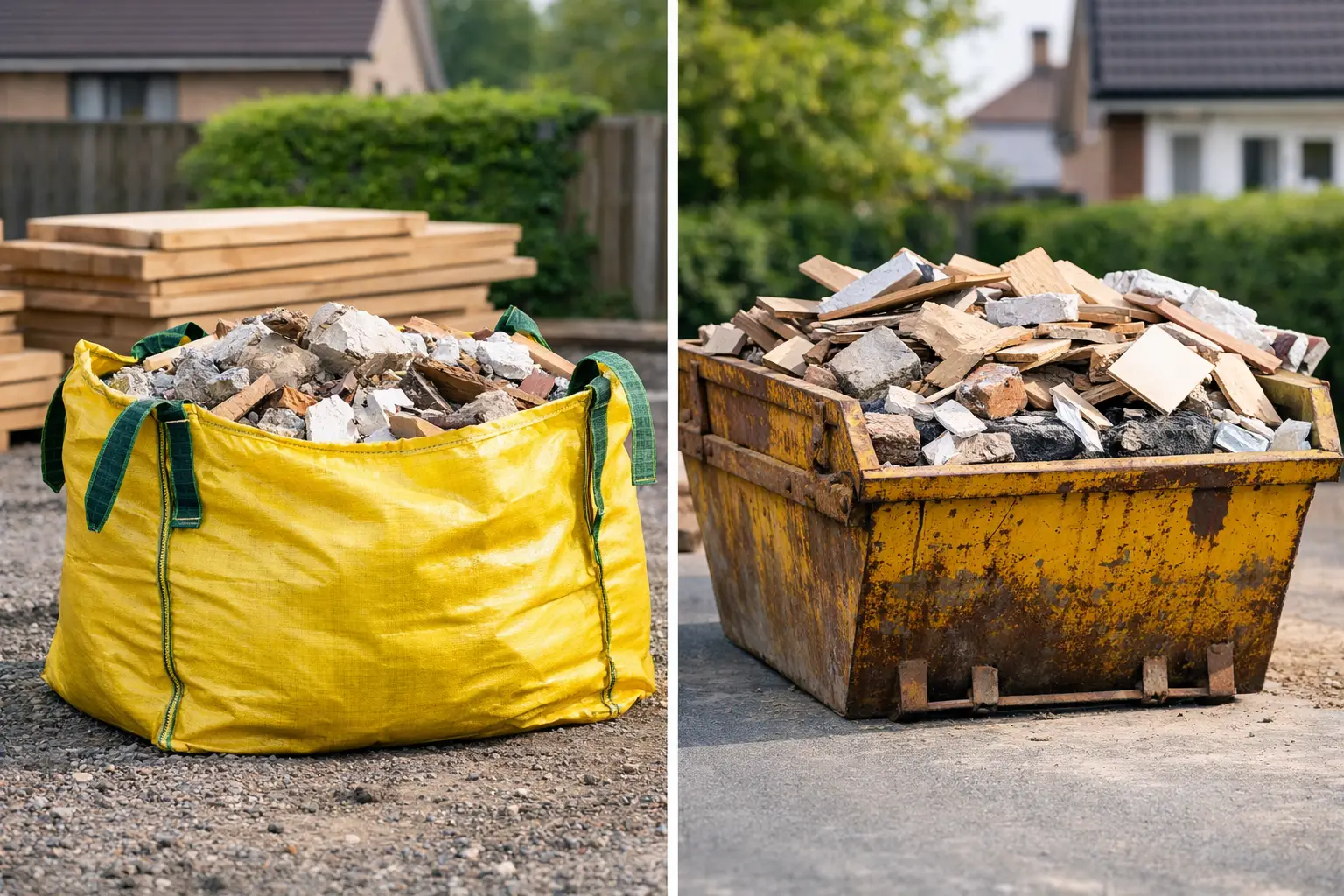
A garden clear-out can look manageable until the old fencing, soil bags and broken furniture start filling the drive. When deciding between a skip bag vs skip hire, the right answer usually comes down to one practical question: how much waste do you have, and where can it sit while you fill it?
Both options make household and light trade waste easier to deal with, but they suit different types of job. A skip bag is flexible and compact before use. A traditional skip gives you far more room and is often the better value once a project starts producing serious amounts of rubbish.
Skip bag vs skip hire: the main difference
A skip bag is a strong, collapsible bag supplied for you to fill, then collected when it is ready. It can be stored flat until you need it, which makes it useful for small jobs where you do not want a large container outside the property from day one.
Skip hire means a metal skip is delivered to your home, site or business premises and collected after you have filled it. Skips are available in several sizes, commonly from smaller 2-yard skips for compact clear-outs up to 8-yard skips for larger renovation, garden and building jobs.
The difference is not simply bag versus skip. It is about capacity, access and how quickly the waste is likely to build up. If you are clearing one room over a few weekends, a bag may be enough. If you are ripping out a kitchen, replacing a bathroom or tackling an overgrown garden, a skip is usually the more straightforward choice.
When a skip bag makes sense
Skip bags work well when the amount of rubbish is limited and you want to keep the job flexible. You might be decluttering a loft, clearing a shed, sorting a spare room before a move, or getting rid of a modest amount of garden waste.
Their biggest advantage is convenience before collection. A folded bag takes up little space, so you can keep it in the garage or shed until you are ready. There is no need to have a skip sitting on the drive while you decide what is staying and what is going.
They can also be a sensible option where space is tight. Some properties in Worthing and the surrounding Sussex areas have narrow driveways, small front gardens or limited room outside. A skip bag may be easier to position than a metal skip, provided the collection vehicle can safely access it later.
That last point matters. Before filling a bag, think about where it will be placed and whether a collection lorry can reach it without obstruction. Do not tuck it behind a locked gate, under low branches or in a spot where parked cars will block access. A bag that is easy to fill but difficult to collect can slow the whole job down.
Skip bags are best for lighter, mixed household waste within their stated limits. They are not a way to dispose of every material. Heavy rubble, large volumes of soil, plasterboard, paint, batteries, electrical items and hazardous waste may need a different disposal route or service. Checking what can be accepted before you begin saves a wasted journey and avoids extra charges.
When skip hire is the better option
Skip hire comes into its own when waste is bulky, heavy or arriving quickly. It gives you a fixed container with clear capacity, making it easier to keep a renovation or clearance site tidy as work progresses.
For example, a 2-yard skip can suit a small bathroom refresh or a compact garden tidy-up. A 4-yard skip is often a practical choice for a garage clearance, kitchen work or several bulky household items. Larger skips are better suited to substantial garden projects, room refits and jobs where a contractor is producing waste each day.
A skip is often more cost-effective than trying to manage a large job through several bags or repeated car trips to the tip. It also keeps waste in one place. That is useful if you are managing trades, preparing a rental property between tenants or clearing a house after a move.
The trade-off is space. A skip needs a suitable place to be dropped and collected, usually on private land such as a driveway. If it needs to go on a public road, pavement or verge, a permit may be required from the local authority. This can take time and may add to the cost, so it is worth discussing the location before booking.
You should also avoid overfilling a skip. Waste must stay below the rim so it can be transported safely. If old doors, timber or furniture are likely to stick up, break down what you can or consider the next size up. Choosing a skip that is slightly too small is a common false economy.
Think about the type of waste, not just the volume
A pile of cardboard boxes takes up plenty of space but weighs very little. Broken paving slabs, concrete, soil and hardcore may fit into a smaller area yet become extremely heavy. This is why the type of material matters as much as the number of bin bags.
For clean, heavy waste, a smaller skip may be the safer and more affordable option. For mixed household rubbish, furniture and light renovation waste, a larger skip can be more suitable. If your waste includes awkward items such as a sofa, mattress, fridge or electrical goods, separate collection may be the easier route rather than trying to put everything in a skip.
Cost, timing and effort: what really affects value?
The cheapest-looking option is not always the one that costs less by the end of the job. A skip bag can be good value for a genuinely small clear-out, especially if you can fill it gradually. But if you need more than one bag, have heavy materials or are clearing bulky items, skip hire can work out better.
Skip hire also saves effort. There are no repeated tip runs, no loading and unloading a car, and no need to store rubbish in the garden while you work out what to do with it. For landlords, property managers and busy homeowners, that time saving can matter as much as the hire charge.
Timing is another consideration. A skip is ideal when you know the work dates and expect waste immediately. A bag is more relaxed when the job has no firm end date. If you are waiting for decorators, sorting a relative’s belongings or clearing a shed in stages, it is useful not to have a collection deadline hanging over you.
For urgent jobs, look for a local provider that can offer quick delivery or collection and give clear advice before booking. D J Recycling helps customers across Worthing and nearby Sussex areas choose a practical waste option, whether that means a skip, a bag or a collection service for items that do not suit either.
Check access before you commit
A quick look at access can prevent most problems. Measure a narrow driveway if you are unsure, move vehicles out of the way and think about overhead cables, trees and low roofs. Tell the provider if the property has a steep slope, restricted entrance or shared access.
If there is no safe place for a skip or bag collection vehicle to reach, rubbish removal may be the better choice. This is especially useful for flats, town-centre properties and homes where waste has to be carried from a rear garden or upstairs room. A clearance team can do the lifting and loading, rather than leaving you to move everything to the kerb.
A simple way to choose
Choose a skip bag if the waste is relatively small, light to moderate, and you want to fill it over time. Choose skip hire if you have a larger volume, bulky materials, renovation debris or a job that needs keeping tidy from the start.
If you are caught between two skip sizes, allow for the fact that clear-outs nearly always grow once you start opening cupboards, sheds and garages. It is better to have enough room than to stack rubbish beside a full skip.
The best waste solution is the one that fits your property, your timetable and the rubbish you actually have. A quick conversation before booking can turn a messy clear-out into a job that is dealt with properly, safely and without extra trips to the tip.
