

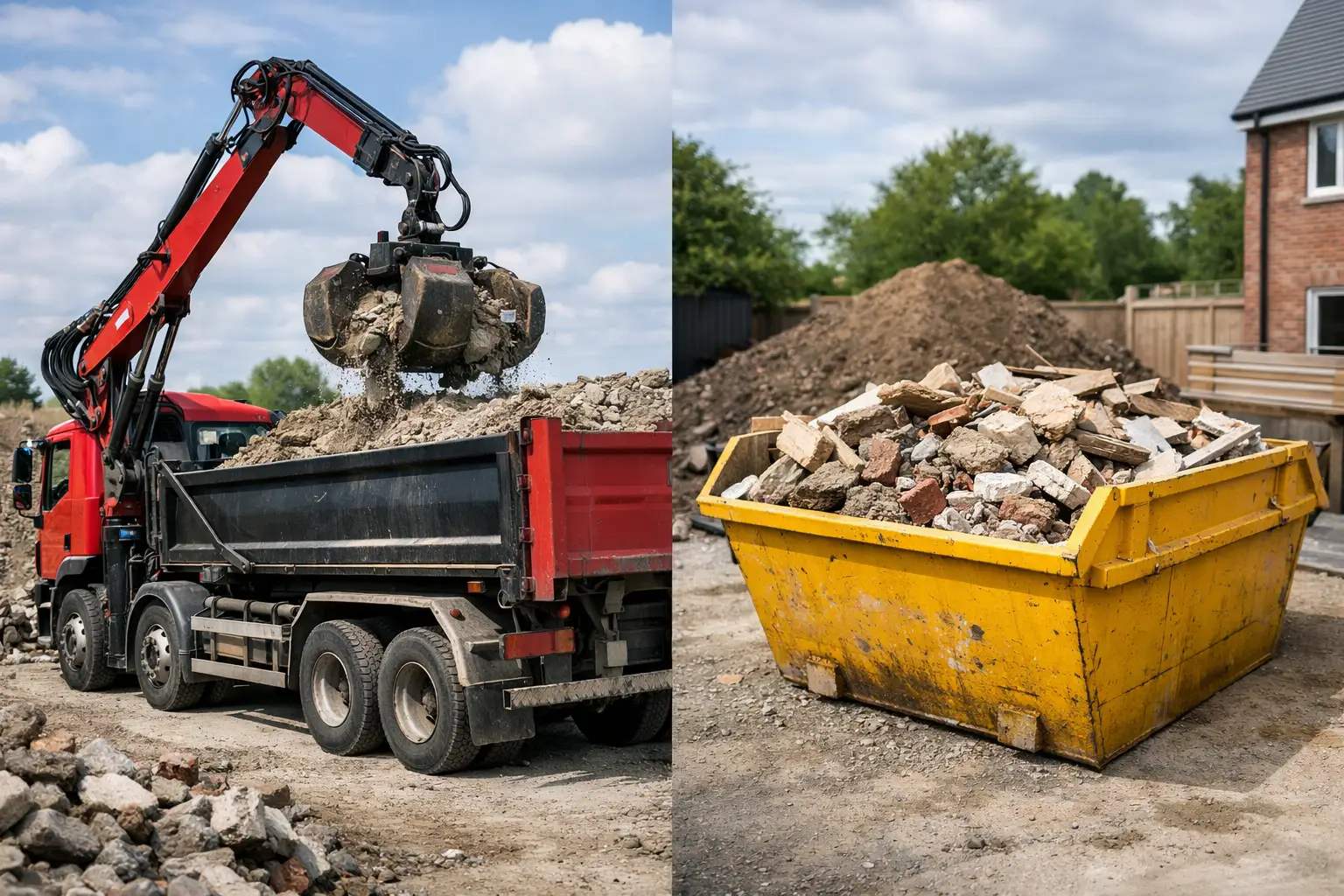
A driveway full of soil, broken paving and hedge cuttings is a very different job from clearing a kitchen during a renovation. That is why the choice between grab lorry or skip hire matters. Both make waste removal far easier, but one may save you time, money and a lot of unnecessary lifting depending on the job.
For homeowners, landlords and small contractors around Worthing and Sussex, the best option usually comes down to three things: what you are getting rid of, how easily the waste can be reached and whether you need time to fill it. Here is a straightforward way to decide.
Grab Lorry or Skip Hire: The Main Difference
A skip is delivered to your property and left for you to fill over an agreed hire period. It gives you the flexibility to work at your own pace, whether you are clearing a garage over a weekend or renovating a room bit by bit. When it is full, it is collected and the waste is taken away.
A grab lorry arrives with a hydraulic grab arm that loads loose waste directly onto the vehicle. It is designed for larger quantities of material that can be placed within reach of the lorry. The collection is often completed in one visit, so there is no container sitting outside your property for days.
Neither service is automatically better. A skip works well when the waste is produced gradually or access is tight. A grab lorry is often the practical choice for large piles of heavy waste where speed is the priority.
When Skip Hire Is the Better Choice
Skip hire is ideal when you need a convenient place to put waste while you work. Rather than creating a growing pile in the garden or on the driveway, you can load materials as you go. This suits kitchen and bathroom refits, garden clear-outs, garage decluttering, house moves and smaller building jobs.
It is also useful when the waste is mixed. General household rubbish, timber, furniture, cardboard, garden waste and renovation debris can often be handled in the same skip, provided prohibited items are kept out. That makes it a simple option for projects where you will not know exactly how much waste is coming until work begins.
The main advantage is time. You do not need everything ready for a collection slot. You can fill the skip in stages, then arrange collection once the job is finished. For many domestic jobs, a 2 to 8-yard skip gives enough capacity without taking over the whole driveway.
There are practical limits to consider. A skip needs a suitable place to sit, ideally on private land with clear access for delivery and collection. If it has to go on the road, you may need a permit from the local council. You also need to load it yourself, which can be difficult if the waste includes lots of soil, concrete or heavy rubble.
When a Grab Lorry Makes More Sense
A grab lorry is built for bulky, loose and heavy materials. Think soil from landscaping, hardcore from a driveway, bricks, concrete, old turf, green waste and large quantities of rubble. If the pile is ready to go, the grab arm can load it far faster than filling a skip by hand.
This is especially useful after groundworks, fencing, patio removal or a major garden project. Instead of paying for a skip and spending hours lifting material over the side, you can place the waste in an accessible pile and have it removed in a single visit.
The grab arm can normally reach over a wall, fence or hedge, which helps when the waste is on a front garden or driveway but not directly beside the road. The exact reach and access requirements should always be checked before booking. The lorry still needs safe space to stop, and overhead cables, parked cars, narrow roads and low branches can affect whether a collection is possible.
A grab lorry is less suitable when waste is being created over several days, or when the pile is at the back of a property with no practical access. It is also not the best answer for a few bags of household rubbish or an old sofa. In those cases, a skip bag, rubbish collection or dedicated bulky-item service may be more cost-effective.
Compare Cost by the Job, Not Just the Price
It is tempting to choose the lowest starting price, but the cheapest-looking option is not always the best value. The right service is the one that removes the full amount of waste with the least extra work and avoids another booking later.
A skip can be good value for a steady flow of mixed waste, particularly when you have the space to keep it on site. However, choosing a skip that is too small can mean paying for a second one. Choosing one that is much too large means paying for empty space.
A grab lorry can offer better value for a substantial pile of heavy material because loading is included and the vehicle carries a large volume. For soil, rubble and hardcore, this can be more efficient than hiring a skip and doing all the loading yourself. But if the material is spread around the property or cannot be reached by the grab, the labour involved in moving it into a pile changes the calculation.
Before booking either service, be clear about the material, the estimated volume and where it will be placed. A quick description such as “a few bags” is rarely enough. Saying whether it is a small garden of green waste, six tonnes of soil, a garage full of mixed items or broken concrete from a patio helps ensure the right vehicle or skip size is sent first time.
Access Can Decide It for You
Access is often the deciding factor between grab lorry or skip hire. A skip delivery vehicle needs room to manoeuvre and set the skip down safely. A grab lorry needs a safe stopping position and a clear route for its arm to reach the waste.
For skip hire, measure the available driveway space and consider gates, parked vehicles and tight corners. Keep the drop-off area clear on delivery day. Do not overfill the skip above its sides, as it cannot be transported safely that way.
For grab collections, make a neat pile where possible. Keep it away from walls, vehicles, trees and cables, and make sure there is nothing mixed into the pile that should not be collected. A pile of soil with timber, plastic sheeting and general rubbish buried through it may need sorting first, which can slow the job down or lead to additional costs.
If there is no off-road space for a skip and no suitable place for a grab lorry to stop, a man-and-van-style rubbish collection or clearance service may be the easier route. This is why a local provider with more than one waste removal option can save time. D J Recycling can help match the collection method to the property and the waste, rather than forcing every job into a skip.
Waste Types Still Matter
Both services have rules around what can be taken. Hazardous materials, including asbestos, chemicals, gas bottles, paint, oils and certain electrical items, usually need specialist disposal. Do not assume these can be put into a general skip or mixed into a grab pile.
Heavy materials also need consideration. Soil, concrete and hardcore are often best kept separate from general waste, particularly in a skip, because weight limits can apply. Separating waste where practical can make disposal simpler and may help more material to be recycled.
If you are clearing a house, flat or tenancy, a skip may not be the most convenient choice at all. Furniture, mattresses, appliances and bagged rubbish can often be collected directly, saving you the job of moving everything outside and loading it yourself.
Choose the Option That Keeps the Job Moving
Choose skip hire when you need several days to fill it, have a safe place to put it and are dealing with mixed household, garden or renovation waste. Choose a grab lorry when you have a large, accessible pile of soil, rubble, green waste or hardcore that needs shifting quickly.
The simplest test is this: if you want somewhere to put waste while you work, book a skip. If the waste is already piled up and ready to go, a grab lorry could be the faster answer. A few clear details about access and materials at the booking stage will help get the right solution on site without delay.
