

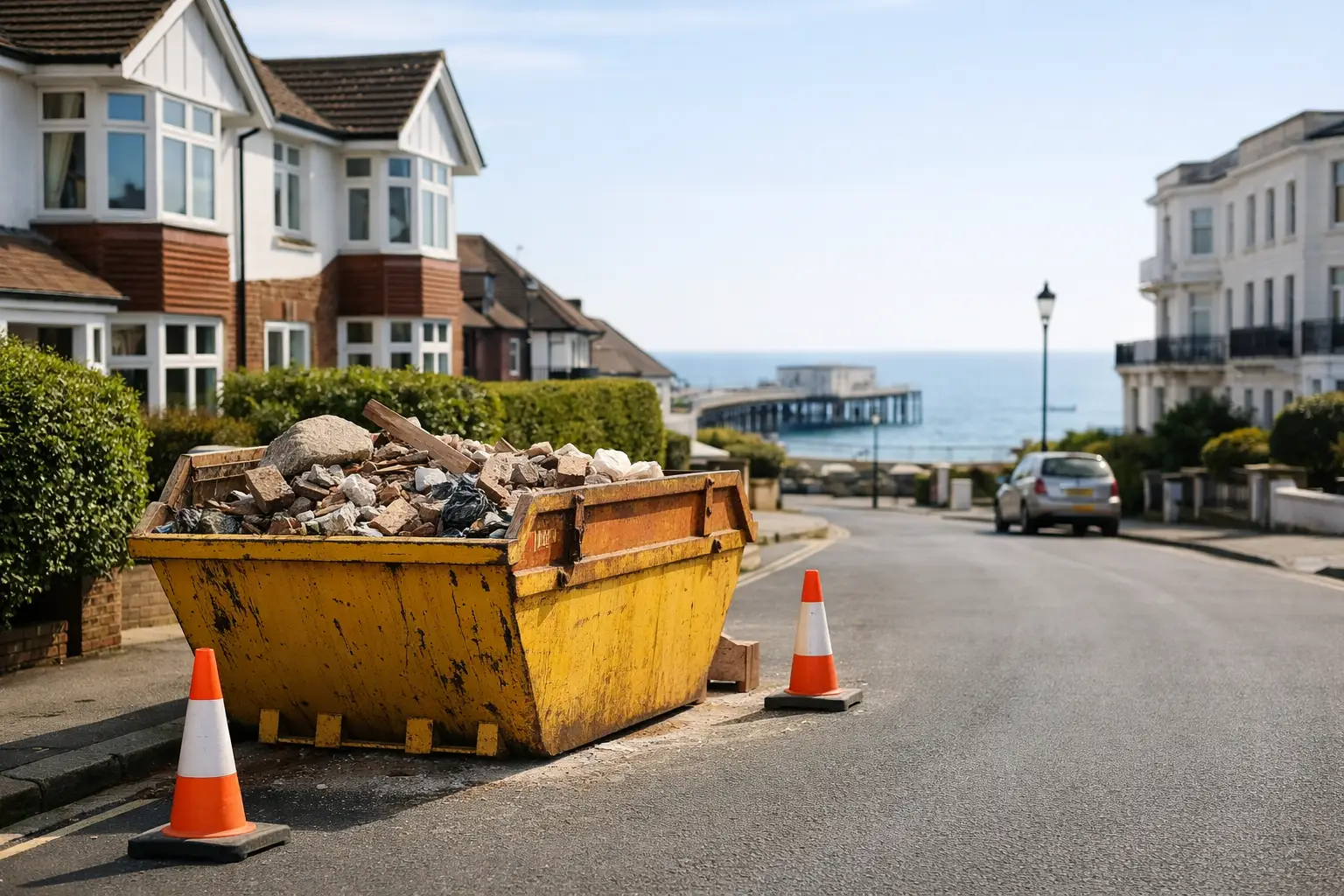
A skip can make a garden clearance, kitchen refit or house move far easier – until you realise there is nowhere on your drive to place it. That is where skip permits explained properly can save time, extra cost and an awkward delivery day. If your skip needs to sit on a public road, pavement or verge, you will usually need permission from the local council before it arrives.
For many homes in Worthing and across Sussex, arranging a permit is straightforward. The key is knowing when one applies, allowing enough time, and giving the hire company accurate details about where the skip will go.
What is a skip permit?
A skip permit, sometimes called a skip licence, is permission from the local highway authority to place a skip on public land. It is not the same as permission from a neighbour, a managing agent or a landlord. The council controls the highway, which can include the road outside your home, parking bays, pavements and grass verges.
The permit helps the council make sure the skip is positioned safely, does not block access, and has the right lighting or markings where required. It also gives the authority a record of who is responsible for the skip while it is on the road.
If the skip is fully on private land, such as your driveway, front garden or a private yard, a skip permit is generally not needed. You still need enough access for the delivery lorry and collection vehicle, but the council licence should not apply.
When do you need a skip permit?
The simple rule is that you normally need a permit when any part of the skip will sit on public highway land. Even if there is space outside your property, do not assume the area is private because you park there regularly.
A permit is likely to be needed when the skip is placed:
- on the road outside your house
- in a council-controlled parking bay
- on a pavement or verge
- in a shared access area that is maintained as highway land
A permit may not be needed for a private driveway, private development road or commercial yard. However, private land can bring its own restrictions. A leaseholder may need approval from the freeholder or managing agent, and a business tenant may need the landlord’s agreement. If access is tight, it is worth checking the available space before booking rather than hoping the driver can make it work on the day.
Who arranges the permit?
In most cases, the skip hire company applies for the permit on your behalf. You provide the delivery address, confirm the intended position and tell them the dates you need the skip. The provider then submits the application to the appropriate council and adds the permit charge to the booking where applicable.
This is usually the easiest route because the permit needs to match the skip company and its insurance arrangements. Do not apply for a permit yourself unless the council and your skip supplier have specifically told you to do so.
When booking, be clear that the skip will be going on the road. It is better to raise it at the first enquiry than to arrange a next-day delivery and discover that permission is still pending. D J Recycling can advise on practical skip placement and whether a permit needs to be arranged for your job.
How long does a skip permit take?
Permit times vary between councils and can change depending on the location, road conditions and demand. Some straightforward applications may be dealt with quickly, while others take several working days. Busy roads, controlled parking areas, town-centre locations and sites near junctions can require more checks.
This is why a permit can affect the delivery date. A company may have skips available for next-day hire, but cannot legally place one on the road until the required approval is in place. If your project has a fixed start date, such as builders arriving or an end-of-tenancy deadline, arrange the skip as early as possible.
Permits are normally issued for a set period rather than indefinitely. If work runs over, tell the hire company before the permit expires. An extension may be possible, but it is not automatic and may involve another council charge.
What does a skip permit cost?
There is no single price for a skip permit. The charge is set by the local authority and can vary by area, permit duration and the type of road. Some locations also need parking suspensions, cones, lights or other traffic management, which can add to the overall cost.
Ask for the permit cost separately when requesting a quote. That gives you a clear picture of the full price rather than comparing skip hire rates alone. It is also sensible to ask how long the permit covers, whether an extension is available, and what happens if the council refuses the application.
For a smaller job, the permit cost can change which waste option offers the best value. If you only have a few bulky items, rubbish collection, a skip bag or a man-and-van style clearance may be more practical than paying for a road permit. For larger renovation, garden or clearance work, a skip can still be the most convenient option because you can load it as the job progresses.
Rules that can affect where the skip goes
A permit is not a guarantee that a skip can be placed anywhere you choose. Councils and skip firms need to consider visibility, pedestrian access, emergency access and traffic flow. A skip should not block a driveway without the owner’s agreement, obstruct a dropped kerb, sit too close to a junction, or create a hazard for people walking, cycling or driving past.
Where a skip is approved for the roadside, it may need lights, reflective markings or cones, particularly during darker hours. The supplier will normally provide the required safety equipment, but do not move it, cover it or remove any markings after delivery.
Keep the area around the skip clear. Do not leave loose bags, timber or furniture spilling onto the pavement. Overfilling a skip is also a problem: waste should stay below the top edge so it can be transported safely. A collection driver may be unable to remove an overloaded skip until the excess has been taken off.
Avoiding common permit delays
Most delays come down to missing information or a site that has not been checked properly. Before booking, look at the space outside your property. Consider parked cars, lamp posts, trees, drains, narrow roads and whether a delivery lorry can pull up safely.
Tell the skip company if you live on a main road, in a controlled parking zone, near a school, or on a road with restricted hours. These details do not necessarily stop the hire, but they can affect the permit process and the best delivery plan.
It also helps to decide the skip size before applying. A 2-yard or 4-yard skip can suit smaller clear-outs where space is limited, while 6-yard and 8-yard skips are often chosen for building waste, larger garden jobs and house clearances. Ordering a larger skip later may mean a new permit or amended approval is needed.
Finally, make sure you can load the skip within the permit period. If you are waiting for trades, deliveries or a property handover, booking too early can leave the skip sitting unused while the clock runs down.
What if a permit is not possible?
Sometimes the road is too narrow, the location is unsuitable, or the council will not approve the application. That does not mean the waste has to stay where it is.
A wait-and-load service can work well where there is no room to leave a skip. The vehicle arrives, you load while it waits, and the waste is taken away without a skip being left on the highway. This suits prepared waste and jobs with enough people on hand to load quickly.
For furniture, mattresses, white goods, bags of rubbish or a full property clear-out, a collection service can be simpler still. The team does the lifting and loading, which is useful for flats, tight streets and homes without off-road space. Grab hire can also be a good option for large piles of soil, hardcore and green waste that can be accessed from the road.
The right choice depends on how much waste you have, how long the work will take, and whether you have a safe place for a skip. A quick conversation before booking can prevent a permit issue from holding up the whole job.
If you are unsure whether the space outside your home needs permission, treat it as a question to resolve before delivery. A few clear details at the start make the rest of the clearance quicker, safer and far less stressful.
